Cardboard Packaging

What is Cardboard
Packaging?

The raw material of paper and cardboard packaging is a highly valuable substance called cellulose. Cellulose is obtained from specially cultivated plants and trees.

Paper and cardboard are preferred because they are easy to process, take up little space during transport and are durable. Cardboard, which can be produced in many different qualities and weights, can be turned into cardboard packaging in countless shapes and styles.

The primary raw material of cardboard-based packaging is paper. Among the papers produced today, packaging paper comes in a wide range of variations. Paper and cardboard packaging are among the most economical packaging types.
Konya cardboard packaging production - İpek Ambalaj offset box printing
Konya fluting paper corrugated cardboard carton production - İpek Ambalaj
Fluting Paper

What is Fluting Paper?

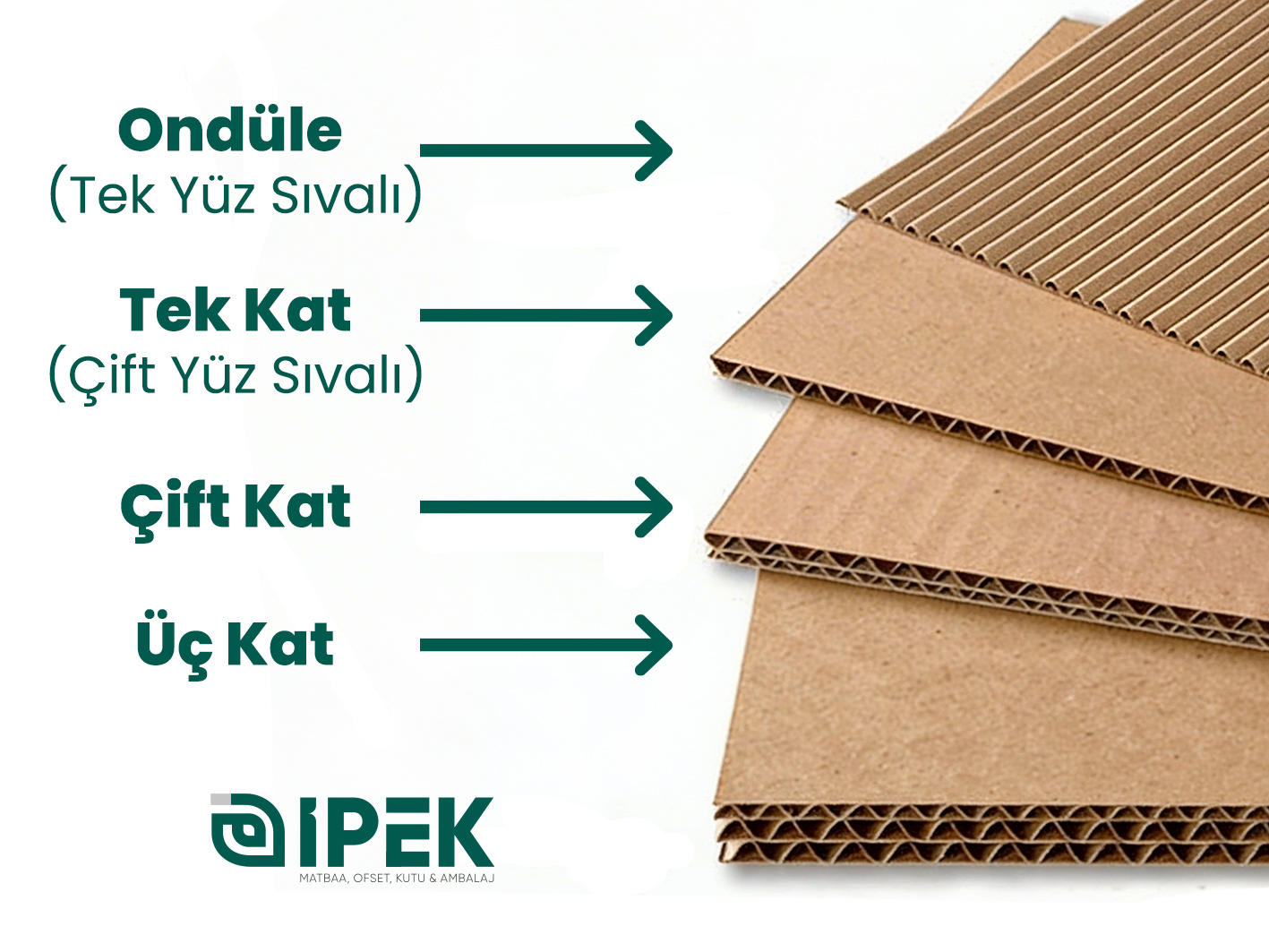
Fluting paper is a type of spiral paper formed by bonding a corrugated layer with a flat sheet. It is mostly used as floor lining and to prevent products from being crushed.

Fluting paper is sold by the kilogram and packaged in roll form. The type of paper used in fluting significantly affects cost; the paper grammage used per square meter ranges from 112 g to 300 g.

Flute Types

Corrugated Box Varieties

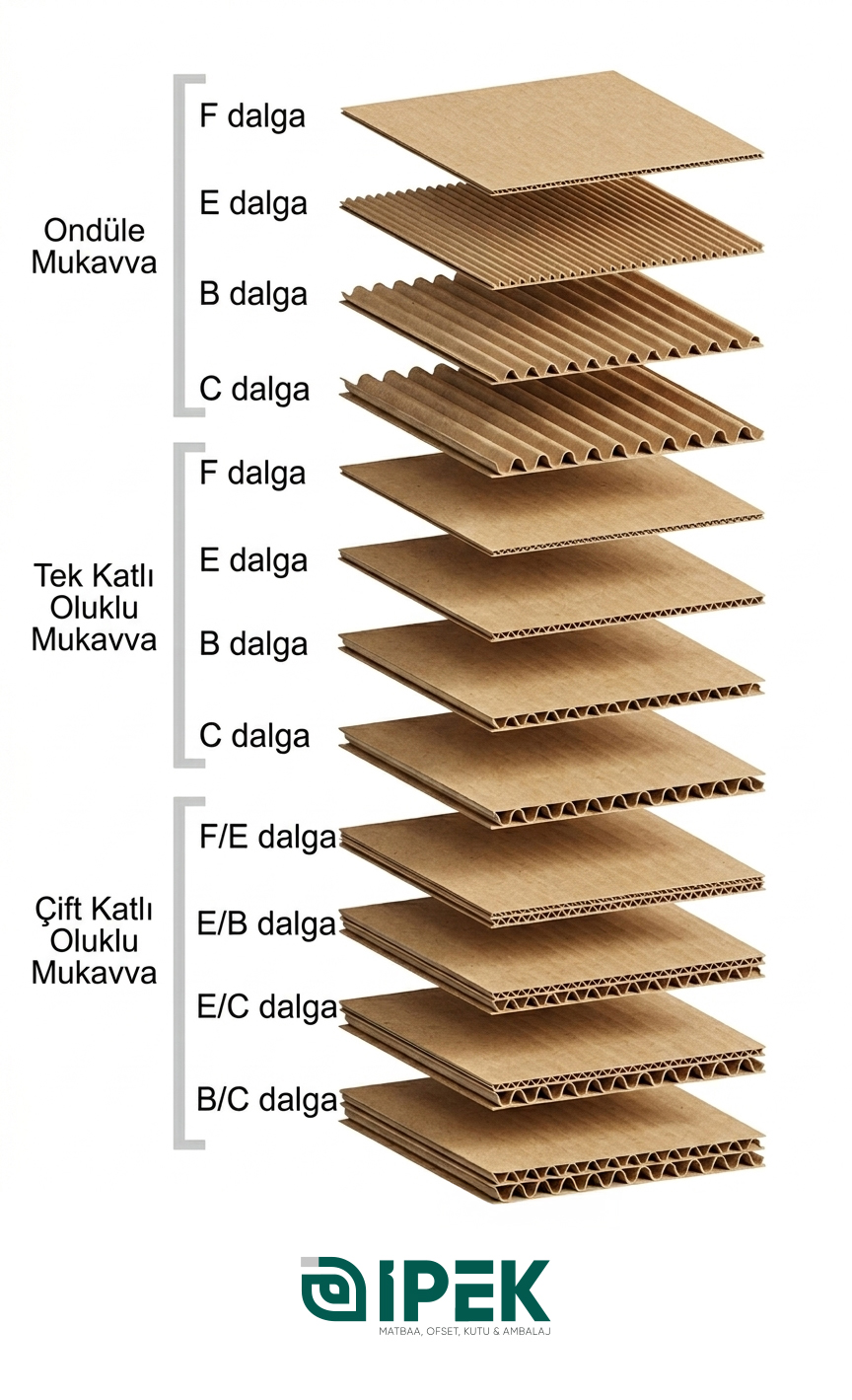
Corrugated cardboard flute types and technical specifications.

E-Flute Micro Flute

Thanks to its high number of flutes per meter, E-flute (micro flute) provides excellent surface crush resistance and the best print result among all flute types. It is also lightweight. It is used for non-durable consumer goods and gift packaging.

Flutes per m: 275–310 Height: 1.15–1.65 mm

B-Flute Fine Flute

Because of its lower flute height and shorter flute spacing, B-flute offers higher resistance to surface crushing than the others. It also has a more print-friendly surface. It is widely used for the packaging of all kinds of products — particularly self-supporting ones — and for the production of die-cut boxes.

Flutes per m: 150–184 Height: 2.1–2.9 mm

C-Flute Coarse Flute

Developed after B-flute and combining the favorable qualities of both, C-flute is a strong carrier. It produces good print results. It is a versatile, durable and economical flute type with a wide range of applications.

Flutes per m: 120–145 Height: 3.5–3.7 mm

F-Flute Ultra Fine Flute

F-flute, the 20% thinner version of E-flute, is purpose-built for ultra-thin packaging. The most recently introduced flute type, N-flute, has 560 flutes per meter at a height of 0.6 mm. With properties closely resembling cardboard, it is well suited to lamination.

20% thinner than E Suitable for lamination

E+B Flute Double-wall — Micro + Fine

Produced as a double-wall (twin) flute by running one micro and one fine flute together through the corrugator. It combines the advantages of both flute types in a single board.

Flutes per m: 150–184 Height: 4.2–5.8 mm

B+C Flute Double-wall — Fine + Coarse

Produced as a double-wall (twin) flute by running one fine and one coarse flute together through the corrugator. It is the strongest flute combination available.

Flutes per m: 120–145 Height: 7.0–7.4 mm
Detailed Information

Advantages of Cardboard Packaging

More durable, thinner, lighter and more economical production using less raw material.

Eco-Friendly

Cardboard packaging produced from cellulose-based raw material is recyclable and breaks down easily in nature.

Light & Durable

We produce cardboard that is more durable yet thinner, lighter and more economical, all while using less raw material.

Versatile Use

With new designs, the use cases for cardboard packaging have expanded. It can be impregnated or laminated to suit different needs.

When the rigidity, burst resistance, protection, and moisture or water-barrier properties of paper and cardboard packaging alone are insufficient, the packaging is treated with various processes depending on the properties of the products it will hold. Cardboard, supported by an additional inner packaging, can be impregnated or laminated. Corrugated cardboard, produced by sandwiching a fluted sheet between two flat papers, has started to replace wooden packaging in many areas of use.

Get Detailed Information
About Our Products

Get in touch with us for the right packaging solution for your needs.